
Year 11 homework and revision can quickly become a long list of things to do. A weekly timetable turns that list into clear, manageable sessions. Start with school deadlines, then make room to practise topics covered in class and at The Tutor Centre. Plan four 45-minute sessions with breaks between them, and give each session a specific task. Starting soon after school also leaves time later in the evening to relax.
At The Tutor Centre, we encourage students to practise at home, check their mistakes and bring questions back to their tutor. A useful home routine makes those steps easier to follow.
Draw Your Week Before You Start
On Sunday, draw a timetable for the coming week. Add tuition, extra-curricular activities and clubs first, and note when each piece of homework is due. Then write in four 45-minute study sessions for each planned study period on school nights and up to eight on weekends.
Put homework with the nearest deadline first. Use the remaining sessions to review and practise topics for upcoming tests, those covered recently at school and in tuition, and key topics that need revisiting which were difficult. Put the timetable somewhere visible and tick off each session when you finish it. At the end of the week, use what you learned to plan next week’s study timetable.
Start Soon After School
When you get home, freshen up, have a snack and get down to your first session. Scrolling, gaming or watching videos straight after school can use up the time and energy you need for effective study. It is easy to put work off until later, then face it when you feel tired.
Save those activities for a brief period later in the evening, after you have completed your planned work. Keep your study breaks for a drink, a stretch, food or a short walk away from your desk.

Give Each 45-Minute Session a Clear Task
Write the topic and the work you intend to complete in each timetable box. “Revise Science” gives you little direction. “Answer and mark six Biology questions on cell division” tells you where to begin and what finishing looks like.
Gather your notes, revision guides and practice questions before you start. Set a timer for 45 minutes. Use the final few minutes to check your answers, correct mistakes or note a question to ask your teacher or tutor. If a topic needs further work, give its next step a place in a later session.
Follow the Four-Session Pattern
A school-night timetable, Monday to Friday, could look like this. Move the start time to fit your journey, tuition and family commitments:
- 4.15–5.00 pm — Session 1: Complete Maths homework on simultaneous equations.
- 5.00–5.10 pm — Break: Get a drink and move around.
- 5.10–5.55 pm — Session 2: Answer Biology workbook questions on cell division.
- 5.55–6.15 pm — Longer break: Eat, rest and step away from your work.
- 6.15–7.00 pm — Session 3: Write an English literature paragraph using feedback from The Tutor Centre.
- 7.00–7.10 pm — Break: Stretch or take a short walk.
- 7.10–7.55 pm — Session 4: Attempt and mark exam-style Physics questions on energy transfers.
That gives you a 10-minute break between the first two sessions, a 20-minute break between the second and third, and another 10-minute break between the last two. The same pattern can fit into the weekend mornings and one afternoon, with the second afternoon off as a reward for adhering to the week’s timetable. Set the clock times around your commitments, while keeping a clear finish to the day and protecting your sleep.
Organise Your Workbooks and Online Resources
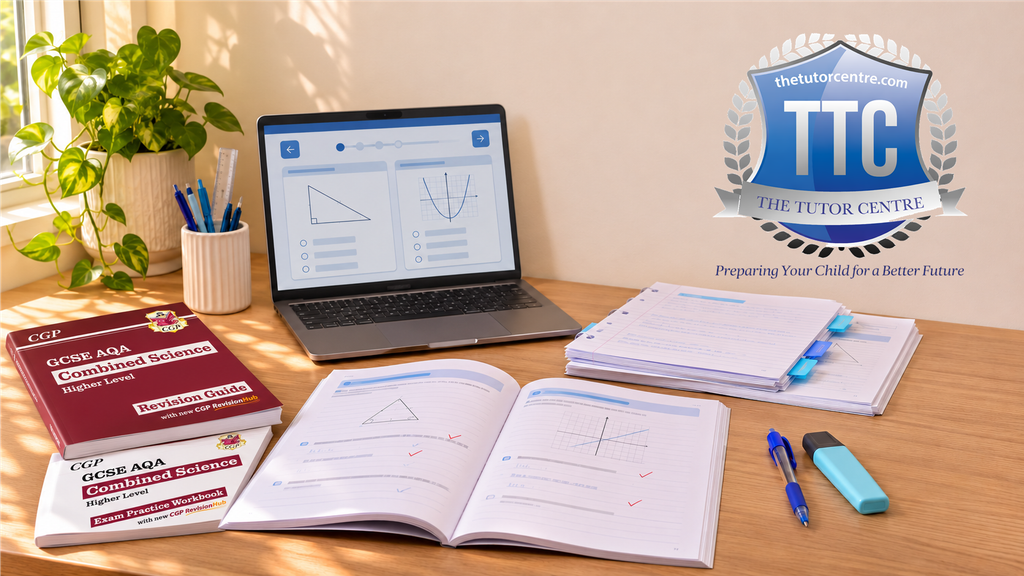
Keep school notes, Tutor Centre sheets, revision guides and practice questions together by subject. A short list of mistakes or questions you could not answer will help you choose future study topics. Do not spend too much time on topics you are comfortable with; focus on the tough ones.
Start with the explanations and examples you were given in class or at tuition. Then try workbook or exam-style questions on the same topic and mark them carefully, studying the mark scheme and learning from it. For anything you got wrong, identify the step that caused the problem and try a fresh question.
Use the internet to fill a specific gap: an explanation of one method, a worked example or more questions. The Tutor Centre staff can recommend suitable resources, including material from your exam board. Keep your search focused so that most of the session is spent doing the work.
Revisit What You Learned at School and Tuition
Within a day or two of a lesson, return to its main topic. Close your notes and write down what you remember, then check for gaps. Complete new questions without looking at the worked examples, mark your answers and record any repeated mistakes.
Do this for topics covered at school and at The Tutor Centre. Bring questions you still cannot resolve to your tutor, and revisit difficult topics in a later timetable. For independent study, The Tutor Centre encourages its students to:
Plan: Choose a clear task, such as six simultaneous-equations questions.
Check as you work: Notice where you get stuck. Check your method against a worked example, and ask your tutor for help at your next tuition session if you cannot move forward.
Review afterwards: Mark your answers, correct mistakes and decide what to practise or ask about when you are next at the Tutor Centre.
Make Room for a Half-Day Reward
Choose a Saturday or Sunday afternoon for a social or leisure activity and put it on your timetable from the start. Once you have followed your planned study sessions, enjoy that half-day with friends, at sport, out with family or doing something else you enjoy.
If an unexpected commitment disrupts a session, move that work to an available slot. A reward you can look forward to helps make a steady routine easier to follow week after week.

The Tutor Centre Difference
At The Tutor Centre, we help our students with producing a study timetable. Furthermore, our Maths, English and Science tuition gives students opportunities to ask questions, practise and learn from mistakes, and then do directed practice at home using the timetable.
Contact The Tutor Centre to find out how we can help your child improve at school and at home.