Daily reading is one of the simplest ways to support a child through primary school, particularly from Year 3 onwards. It helps them enjoy stories, understand new ideas and grow in confidence long before they sit their Year 6 SATs. With phones and tablets competing for attention, and Youtube shorts degrading attention spans, a regular reading slot gives children the time to settle into a book and think about what it means.
That slot need not be long. Fifteen to 20 enjoyable minutes is a useful starting point for many families, and gradually extending it as the child becomes accustomed to regular reading. Choosing the right text and talking about it matter more than racing through pages.
Reading Well Means Understanding
Being able to say the words accurately is an important step. As reading becomes more fluent, children have more attention available for the story or information behind those words. They can follow events, notice clues, ask questions and check whether what they have read makes sense.
Reading also builds vocabulary and knowledge. A story may introduce a new setting or another person’s feelings; a non-fiction book may explain a scientific idea or a moment in history. The words and ideas children encounter develops their speaking and writing skills as well.
These skills reach beyond English. Year 6 children will sit two maths reasoning papers during the KS2 SATS exams in which they must understand what is being asked before choosing a calculation. In science, they need to read an explanation, understand terms such as compare and explain, and use evidence to answer a question.
Listen to Your Child Read Aloud
For primary children, a parent listening to them read aloud turns a school expectation into a warm, shared routine. Choose something your child wants to read and can manage with a little support. Let them try a difficult word, help when needed and praise the effort of making sense of the sentence.
Try not to interrupt at every hesitation. If reading feels tiring, take turns with a page each. You can also read a more challenging book to your child. Listening lets them enjoy richer stories and vocabulary while their own reading catches up.
After a short passage, talk naturally about it. A few useful questions are:
- What happened, and where did you find that in the text?
- What do you think this word means here?
- How might the character be feeling? What gives you that idea?
- What do you think might happen next, and why?
One thoughtful question is enough. The aim is a conversation, not a test after every page.
Help Them Read Between the Lines
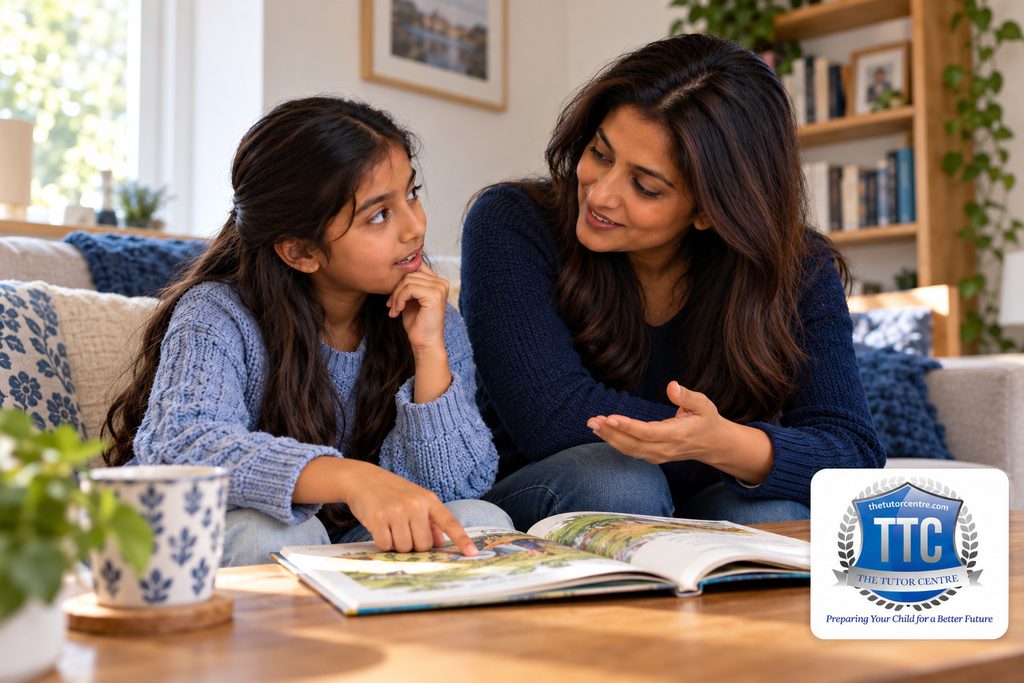
The question about a character’s feelings practises inference: working out what a writer suggests without stating it directly. Suppose a story says, Maya folded the letter, pushed it under her book and looked away. A child might think Maya is worried or does not want to discuss the letter.
Ask, Which words made you think that? The child learns to connect an idea to evidence. There may be more than one sensible answer, provided they can explain it using the text. This habit becomes increasingly useful as KS2 books and questions grow more demanding.
Make New Vocabulary Stick
Encourage your child to notice one or two unfamiliar words during a reading session. First, see whether the surrounding sentence offers a clue. Then explain the word, say it aloud and use it in a new sentence together. Bring it into conversation again a few days later.
For example, if a character is reluctant to enter a room, ask what the character does that suggests reluctance. Your child could then use the word to describe something they once felt unsure about doing. Understanding a word in context and using it for themselves is more valuable than copying a definition.
How Does This Help with Year 6 SATs?
The KS2 English reading test asks children to understand different kinds of text, including fiction, non-fiction and poetry. Questions may ask them to explain a word in context, find information, summarise ideas, make an inference and justify it with evidence. They read and answer within a set time, so confident, fluent reading helps.
The conversations above practise these same ways of thinking without making every evening about an exam. Past papers become useful as SATs approach, but reading regularly gives children more time to build the underlying skills. A child who enjoys reading is also more likely to keep practising.
A Routine You Can Start Right Away
- Let your child choose: Offer a manageable book or text linked to their interests, with a mix of stories and non-fiction over time. The Tutor Centre makes books available to students to choose and take home to read.
- Make a small daily slot: Try 15 to 20 minutes at a time that works for your family.
- Listen and join in: Hear them read aloud, help with difficult words and sometimes read a passage to them.
- Ask about meaning: Discuss one new word, a character’s feelings or a clue about what may happen next.
- Keep it enjoyable: Finish while reading still feels positive, and return to the book tomorrow.
By the end of Year 6, children need reading skills that carry them into every subject at secondary school. The habit you build together in primary gives them a foundation for reading more independently at KS3 and, in time, for GCSE English Language.
And finally, what better way to bond with your child in the primary years than developing a love for reading with them!
The Tutor Centre supports Derby students with English from KS2 through GCSE. If your child finds reading comprehension or explaining their answers difficult, we can help identify the skills to work on next.