The reading habits children develop in primary school do not stop mattering after Year 6. As we discussed in Part One, on reading in primary school, vocabulary, discussion and finding clues in a text form a strong foundation. In secondary school, students must use those skills more independently. They meet longer texts, unfamiliar ideas and the particular language of each subject.
The distraction of phones and social media makes sustained reading harder to fit into the day. Yet a teenager who can stay with a chapter, article or explanation has more opportunities to build knowledge, test ideas and express a reasoned view. This matters from Year 7 through to GCSE.
Independent Reading at KS3
Secondary students need time to read by themselves. Fiction, biography, journalism and accessible non-fiction can all help, especially when the subject interests them. A manageable starting point is 15 to 20 minutes on most days, with the phone put aside. Shorter texts can help a reluctant reader rebuild the habit before moving on to a whole book.
Parents still have an important role, although they need not listen to every page. Ask occasionally what surprised your child, whether they agree with an author’s view or what they think may happen next. Keep the conversation relaxed. Reading for pleasure and reading to learn can support each other.
At KS3, students are expected to tackle increasingly challenging material, learn vocabulary from context, make inferences and support their ideas with evidence. They also begin to judge how language, structure and viewpoint shape a reader’s response. These are skills to practise and improve, rather than talents a student either has or lacks.
Helping Students Read Beyond the Words
At The Tutor Centre, we help students understand both what a text says and what it suggests. They learn to recognise a writer’s viewpoint, make sensible inferences and explain their ideas using evidence. When a passage is difficult, our tutors guide students to examine it more closely and express their thinking clearly.
This support develops as students progress from Year 7 to GCSE. They become more confident with unfamiliar fiction and non-fiction, and better able to analyse and evaluate what they read in exam answers. The same careful reading helps them interpret sources in history, follow explanations in science, and understand what a maths question is asking.
These techniques give our students a way to remain on track when reading a story or an extract when “I don’t understand” would otherwise be the end of the conversation.
Why Reading Matters in Every Subject
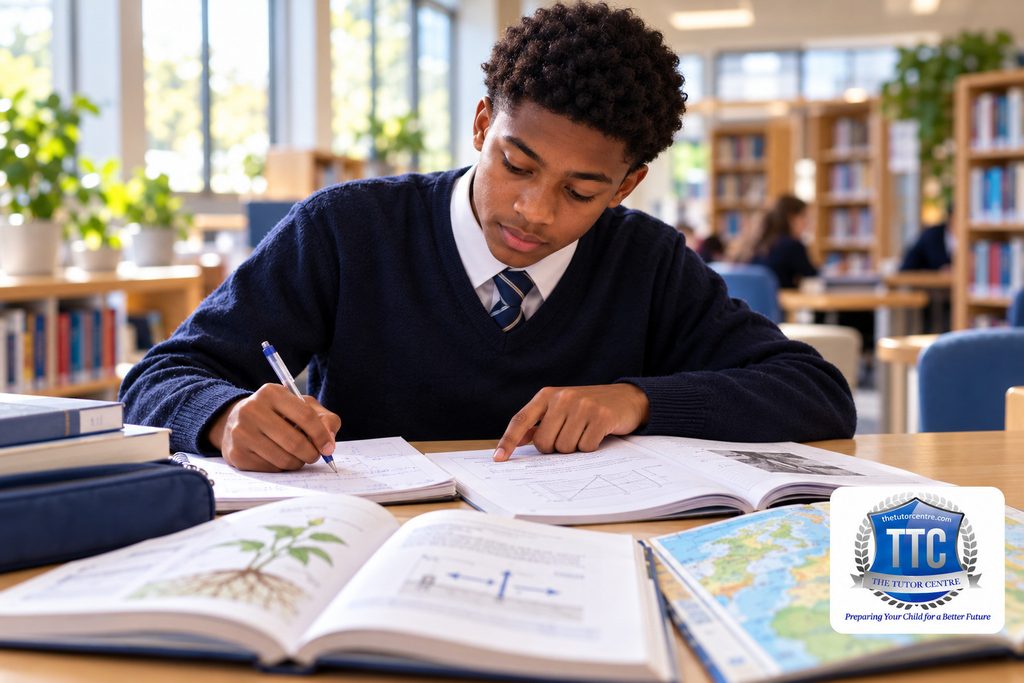
Each subject has its own ways of reading, writing and explaining. A student learns more when they understand both the content and what the question asks them to do.
In history, they may infer a source’s viewpoint, consider who produced it and judge how useful it is. In geography, they may interpret a map, graph or case study, identify a pattern and explain a possible cause. These answers require careful reading of evidence rather than a collection of memorised facts.
In science, students must follow explanations and practical methods, understand precise terms and distinguish describe from explain or evaluate. A question may require them to infer what a pattern in the data suggests and assess whether the evidence supports a conclusion.
In maths, reading a word problem accurately helps a student decide which information matters and what calculation or reasoning is needed. Words such as at least, per and remaining can change the answer. Here, inference may mean working out the relationship implied by the situation before choosing a method. Strong reading supports mathematical thinking; it does not replace it.
From Year 7 to GCSE English Language at The Tutor Centre
At The Tutor Centre, we build these skills in stages, so that students can approach unfamiliar texts with a method and explain what they have understood.

- Year 7: We focus on secure comprehension, useful vocabulary and the habit of checking meaning. Students learn to summarise a passage, ask questions and connect a simple inference to a detail in the text.
- Years 8 and 9: Students meet more challenging fiction and non-fiction. They examine how a writer creates an impression, compare viewpoints and practise explaining why the evidence supports their interpretation. Structured discussion helps them turn an initial thought into a clear written answer.
- Years 10 and 11: Students apply these habits to GCSE style unseen texts. They practise selecting relevant evidence, analysing language and structure, comparing perspectives, evaluating effectiveness and writing with a clear purpose under timed conditions.
GCSE English Language assesses these skills: AQA, Paper 1 uses an unseen fiction extract and Paper 2 uses linked non-fiction and literary non-fiction. Edexcel English Language has a fiction and imaginative writing paper followed by a non-fiction and transactional writing paper. Across these papers, students interpret implied ideas, analyse and evaluate writers’ choices, support points with evidence and write for different purposes. Regular reading gives them repeated experience of how writers create meaning; guided practice through tutoring at The Tutor Centre helps them explain that meaning clearly in an exam answer.
The same habits help students produce stronger responses elsewhere. A well supported interpretation in history, a careful conclusion in science or an accurate reading of a maths problem all depend on understanding language and using evidence. Better reading creates opportunities for higher marks across subjects, while subject knowledge and practice remain essential. While parents appreciate the importance of maths and science for elite careers, the importance of English is often overlooked when seeking tutoring for their children which often limits their attainment in those GCSEs.
A Realistic Routine at Home
Encourage your teenager to choose something they genuinely want to read and schedule a short, regular slot. Over time, include stories and factual writing. If a book is too difficult or uninteresting after a fair try, help them choose another.
If reading remains slow or exhausting, then this will likely result in your child falling behind across all subjects. Contact us to discuss the specific difficulty, and we will advise the support required depending on whether the barrier is fluency, vocabulary or comprehension.
Daily reading is a small habit with a long reach. From the first independent book in Year 7 to an unseen GCSE extract, students benefit from knowing how to clarify, infer, question and evaluate. At The Tutor Centre in Derby, we help students develop those habits alongside their English tutoring across the secondary years, with skills they can use throughout the curriculum.